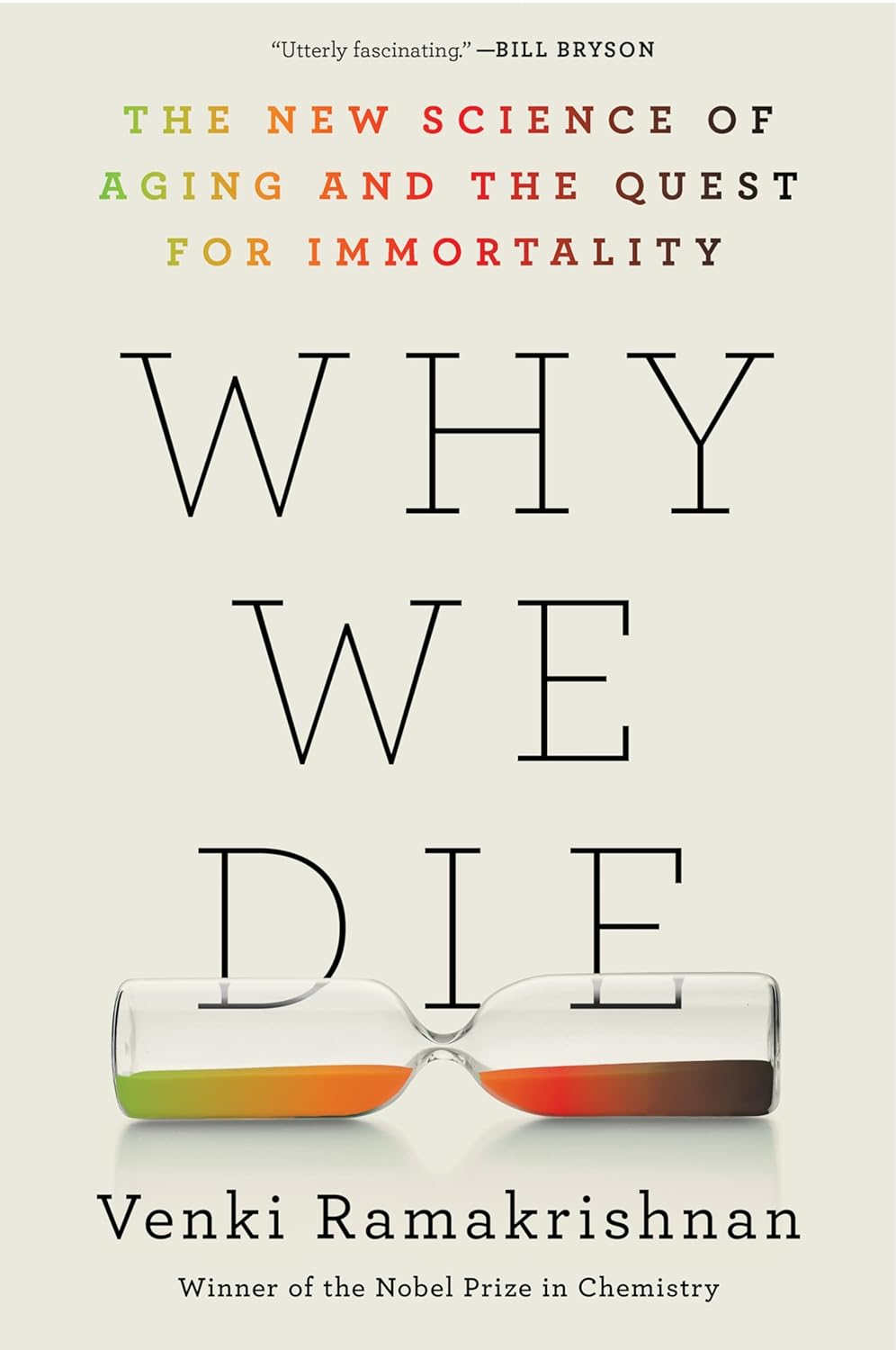
Nobel Prize-winning molecular biologist Venki Ramakrishnan explains the science of aging and death, the quest for longer life, and the ethical questions raised by modern biology and longevity research.
Author: Venki Ramakrishnan Format: Paperback Publisher: William Morrow Publication date: February 18, 2025 Pages: 320 Language: English ISBN:978-0063113275, 978-0063113282
The knowledge of death is so terrifying that we live most of our lives in denial of it. One of the most difficult moments of childhood must be when each of us first realizes that not only we but all our loved ones will die—and there is nothing we can do about it.
Or at least, there hasn’t been. Today, we are living through a revolution in biology. Giant strides are being made in understanding why we age—and why some species live longer than others. Could we eventually cheat disease and death and live for a very long time, possibly many times our current lifespan?
Venki Ramakrishnan, recipient of the Nobel Prize in Chemistry and former president of the Royal Society, takes us on a riveting journey to the frontiers of biology, asking whether we must be mortal. Covering the recent breakthroughs in scientific research, he examines the cutting edge of efforts to extend lifespan by altering our physiology. But might death serve a necessary biological purpose? What are the social and ethical costs of attempting to live forever?
Why We Die is a narrative of uncommon insight and beauty from one of our leading public intellectuals.
About the Author
Venki Ramakrishnan shared the 2009 Nobel Prize in Chemistry for uncovering the structure of the ribosome. A member of the National Academy of Sciences, Venki runs the Ramakrishnan Lab at the MRC Laboratory of Molecular Biology in Cambridge, England. From 2015 to 2020, he served as president of the Royal Society, one of the world's oldest scientific organizations. He is the author of the frank scientific memoir Gene Machine.
Reviews
"Ramakrishnan is a fine writer, so readers will enjoy his expert if intensely detailed overview of genetics and evolution as it applies to aging. ... Fascinating. ... An illuminating account of the science of life extension with a more critical eye than most."
Kirkus Reviews
“Highly accessible. ... Poetic. ... Throughout this authoritative book there is a sense of our bodies as complex systems in delicate balance—a balance we still barely understand.”
The Times (London)
"Why We Dieasks whether it is possible to arrest the decay of body and mind. ... [Ramakrishnan] has a jauntily accessible style. He likens a breakdown in vital proteins to an orchestra playing discordantly. When discussing how the energy-generating mitochondria in cells degrade over time, he pictures them 'rusting from within.' ... Boosting your lifespan may beguile the imagination but could rob your existence of meaning, because there is no urgency to make every day count. Perhaps, after all, life’s transience is the key to its beauty."
The Economist
Choosing a selection results in a full page refresh.